How VyMetric's AI Stays Accurate When Your Body Changes
Most fit-tech companies use AI to recommend a size. VyMetric uses AI for something harder: keeping your Biometric ID precise across a scan, across every brand, and across every kilogram you gain or lose. Three roles, one engine, one body that the system has to keep up with.
AI is doing more than you think
Most fit-tech companies talk about AI as if it were a single thing: a recommendation algorithm that takes a guess at your size. That framing is a marketing convenience. The real work happens before the recommendation, and continues after it. By the time the size suggestion appears on the screen, three different AI systems have already done their share of the work, and a fourth is waiting for the next time the user logs in.
This article walks through what each stage actually does, why each is hard, and why the combination is what makes a Biometric ID accurate, durable, and worth carrying across brands.
Stage 1: From raw scan to 240+ measurements
When someone steps into a VyMetric Totem, the kiosk captures a dense 3D point cloud of the body. That point cloud is not a measurement. It is a few hundred thousand spatial coordinates that describe the body's surface at a moment in time. To turn that into the 240+ measurement points the platform actually publishes, the AI has to do work that no measuring tape could do reliably.
Three things have to happen, fast and accurately:
Landmark detection. The model has to identify anatomical reference points. Where exactly is the seventh cervical vertebra? Where is the natural waist, as opposed to the apparent waist when posture shifts? Where is the bust apex, the elbow crease, the knee center, the lateral malleolus? Each landmark is the anchor for a class of measurements that follows.
Measurement extraction. Once landmarks are placed, the model computes circumferences, lengths, depths, and proportions between them. A waist circumference is not the perimeter of a horizontal slice through the point cloud. It is the path that a tape would actually take, accounting for posture, breathing phase, and soft-tissue compression that real-world tape measures cause.
Quality scoring. The model assigns a confidence value to every measurement it produces. A perfectly captured shoulder width with clean point coverage gets a high score; an inseam measured through a baggy garment gets flagged for re-capture. Quality scoring is what turns a scan from an artifact into infrastructure.
The Mobile Body Scan app does the same job from a different starting point: a phone camera capture instead of a dense kiosk scan. Fewer raw points, but the same AI architecture, tuned to be reliable on consumer hardware. The mobile app produces 85+ measurements; the Totem produces 240+. Both feed the same Biometric ID.
Stage 2: Matching the body to every brand
A Biometric ID is useful only if a brand can do something with it. The catch is that no two brands describe their garments the same way. A "size 8" dress at one brand has different chest, waist, and hip dimensions than a "size 8" dress at another. A "32 inseam" pant at one brand sits differently on the body than a "32" at the next. Sizing is not a standard, it is a thousand opinions.
The matching engine has to translate between these opinions. The brand uploads its tech-pack data: garment measurements, ease (how much room the garment leaves around the body), grading (how the garment scales between sizes), and sometimes fabric stretch. The AI compares those garment specs against the user's Biometric ID and predicts how the garment will sit on that specific body, in that specific size, at the brand's intended fit.
This is harder than it sounds. The model has to learn each brand's aesthetic intent: Brand A cuts oversize on purpose, Brand B cuts slim on purpose, Brand C grades up by the same delta at every size while Brand D uses different deltas above and below a certain threshold. Once the engine knows the brand's grammar, the recommendation it returns is not a guess. It is a translation.
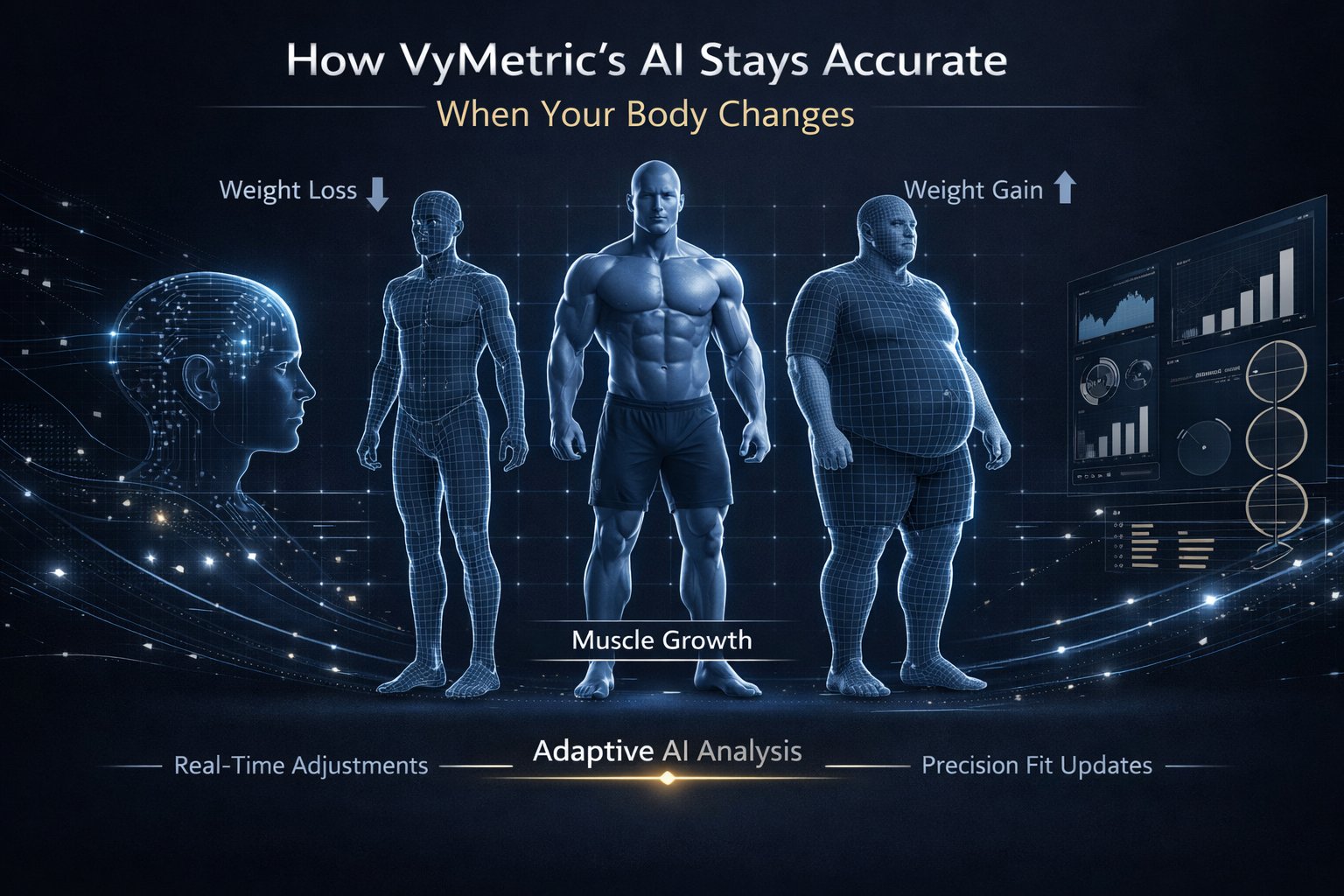
Stage 3: Recalculating when the body changes
This is the role of AI that most people do not realize is happening. Bodies change. People gain weight, lose weight, train, give birth, recover from injury, or just age. A measurement taken a year ago is not the same measurement today. If the platform required a fresh full scan every time the body changed, the Biometric ID would be useless for ongoing recommendations.
VyMetric's AI handles this with predictive recalculation. The user updates a single signal in the Portal or Mobile app, typically weight, sometimes a body-composition reading, occasionally a target like 'I'm training for a marathon.' The model uses that one signal to re-derive the rest of the body, drawing on patterns it has learned from millions of similar transitions: how a 3 kg gain typically distributes across the trunk versus the limbs, how training redistributes circumference and depth differently from sedentary weight change, how aging shifts proportional ratios in directions that are systematically different from year-over-year fluctuation.
The result is a Biometric ID that stays accurate without forcing the user to re-visit a kiosk. A user who scans once and then updates their weight a few times a year gets continuous, recommendation-grade accuracy with almost no friction.
When the predictive recalculation has accumulated too much drift, or when the user makes a large change (significant weight shift, post-pregnancy, recovery from a major injury), the system suggests a re-scan. The user is in control of when that happens. The system tells them when it would help.
Why this matters as a technical pillar
The three AI roles above are not interchangeable. Each one solves a different problem and is held to a different standard. Together they are what make the Biometric ID possible.
Why the user can trust what the AI does
AI in body data only works if the user trusts it. Trust does not come from a marketing claim. It comes from architecture. Three things VyMetric's AI is designed to do, and three things it is explicitly designed not to do.
What it does:
- Scores its own confidence on every measurement and surfaces low-confidence ones to the user, instead of pretending every value is equally accurate.
- Lets the user inspect, correct, or override any measurement they disagree with, and learns from the correction.
- Suggests a re-scan when predictive recalculation has drifted past its useful range, instead of silently letting accuracy decay.
What it does not do:
- Train the production model on identifiable user data. The Biometric ID stays with the user. Population-level model improvements use anonymized, aggregated patterns.
- Apply the user's data to anyone else, or apply anyone else's data to the user. Each Biometric ID is the user's own, calibrated only by the user's own scan and updates.
- Hand brands raw measurements. The matching engine returns recommendations and AR renderings. The brand never receives the underlying measurement set.
The body is the passport. The AI keeps it valid.
A passport that is accurate the day it is issued and slowly drifts out of date is not actually a passport. It is a souvenir. For a Biometric ID to deserve the name, it has to stay accurate as the body it describes changes. That is what the AI is for.
Extraction makes the ID exist. Matching makes it useful. Predictive recalculation makes it durable. Three stages, one engine, one body that the system has to keep up with. The user scans once, updates a signal here and there, and gets a portable record of their body that travels with them across brands and across years. That is what AI looks like when it is doing the work that actually matters.
The body is the passport. We issue the ID.