Size Recommendations as a Service: The Case for a Scalable Fit API
Apparel brands lose billions every year to a problem they cannot solve alone: customers cannot tell what size will actually fit them. VyMetric is building the shared layer that fixes it.
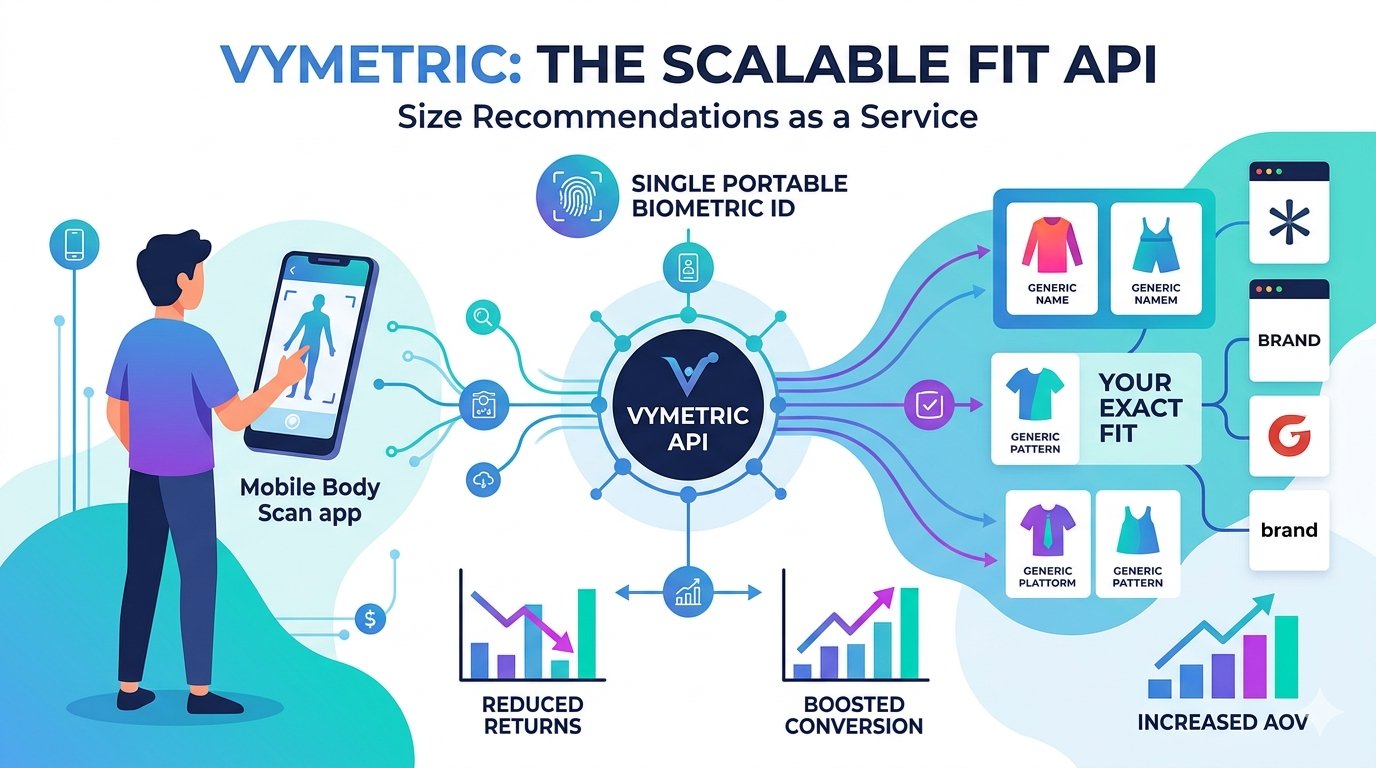
The leak nobody can patch alone
Online apparel return rates sit between 20% and 30% for most categories, and the leading reason isn't quality, isn't shipping, isn't buyer's remorse. It's fit. Every return is a hit on margin, an addition to reverse-logistics cost, and a quiet reduction in customer lifetime value. For most ecommerce teams, fit-driven returns are the largest leak in the funnel they have no real lever to fix.
The standard tools have not moved the needle. Static size charts assume a shopper who has measured themselves accurately, in the right places, against a brand-specific reference. "What size am I?" widgets ask the shopper to remember their measurements from a different brand. Recommendation models trained on past purchase data inherit the same returns problem they are trying to solve, because the training set is contaminated by every customer who ordered the wrong size and kept it.
The fix is a layer, not a widget
VyMetric is building a Biometric ID: a portable, validated body profile generated from a single scan, either at one of our in-mall Totem kiosks or through our Mobile Body Scan app. The Totem captures more than 240 measurement points. The mobile scan captures more than 85. Both feed the same Biometric ID, and the same ID can be used by any brand integrated with our API.
For the customer, this means measuring once and getting accurate size recommendations everywhere they shop. For the brand, it means access to the most reliable signal in apparel commerce: the actual body the garment is being sold to.
How brand integration works
For brand teams, the integration story is intentionally light.
A brand's site or app calls the VyMetric API at the moment of size selection, on a product page or in the cart. The API receives the customer's Biometric ID (with the customer's consent, managed by VyMetric) and returns a fit recommendation specific to that SKU and that brand's size taxonomy. If the brand uploads its tech pack or a measurement chart for each style, recommendations get sharper. If not, our defaults still substantially outperform a static chart.
Behind the API:
- The Biometric ID is recalculated dynamically. Weight changes, postural shifts, and re-scans are reflected without forcing customers to re-measure.
- The recommendation engine accounts for fabric stretch, fit intent (tailored, relaxed, oversized), and brand-specific grading.
- Privacy is handled at the platform level. Brands receive a recommendation, not raw body data.
A brand can be live in a sprint, not a quarter. There is no need to build a measurement experience, manage scan hardware, or train a model. Those are our problems.
Why this matters for brands
The economic case is direct.
Returns reduction. Fit-driven returns are the largest correctable category of returns. Even a single-digit percentage-point reduction flows almost entirely to gross margin.
Conversion lift. Sizing anxiety is one of the most consistent reasons for cart abandonment in apparel. A confident size recommendation, surfaced at the right moment, removes that hesitation.
Higher AOV. Customers who trust the recommendation buy in their actual size and add complementary items, instead of ordering two sizes "to see which fits."
Repeat purchase. A returning customer with a saved Biometric ID shops faster, with less friction, and with fewer returns each time. Cohort LTV improves measurably.
These outcomes are not theoretical. They are the same wins fit-tech has produced in pilot deployments for nearly a decade. What has been missing is a portable layer customers actually use across brands. That is what changes when the ID lives with the customer, not with one retailer.
The SaaS API model: scalable MRR
For VyMetric, the model is a SaaS API with usage-based components: a base subscription per brand that covers integration, dashboard access, and a baseline of API calls; metered tiers for higher volume; and premium modules for advanced fit personalization, returns analytics, and tech-pack ingestion.
This structure produces scalable MRR.
For a brand, the result is a line item on the operations side: predictable, billed monthly, scaling with usage. For VyMetric, it is a revenue model where success is shared with the brands and customers we serve.
A shared layer, not another silo
Apparel sizing has been broken for as long as apparel has been sold online. Every brand has tried to fix it locally, on its own product pages, with its own data. None of them were ever going to.
The fix is a shared, customer-owned layer. Scan once. Get a recommendation everywhere. An API your team integrates in a sprint, with predictable economics and a customer experience that compounds in your favor with every other brand that joins.
If you are a brand interested in early integration, a partner exploring distribution, or an investor tracking the category, we would like to talk.
The body is the passport. We issue the ID.