Custom Apparel & Made-to-Measure: When Fit Becomes a Data Problem
For most of fashion's history, getting clothes that actually fit you meant one of two things: pay a tailor, or get lucky. The middle didn't exist. Until now.
Off-the-rack was built on averages
Standard sizing was designed around fit models who represent almost no real shopper. A "size 8" or a "size 40R" is a category drawn from population averages, not a description of any single body. When you try on an off-the-rack garment, you are not being measured against your shape, you are being asked: does the shape of the average match yours closely enough to be wearable?
For most people, most of the time, the answer is no, but only by a little. Just enough that the garment is "fine." Just enough that returns happen. Just enough that closets fill up with items rarely worn.
Made-to-measure was always the answer to that gap. Until recently, it just wasn't reachable.
What "made-to-measure" actually means
The terms get used interchangeably, but they shouldn't be. Three categories matter:
Made-to-measure is the sweet spot. It delivers most of bespoke's fit advantage at a fraction of the cost and time. It's also the category most poised to scale, because the bottleneck has never really been the manufacturing. It's been the measuring.
Why custom apparel stayed niche
Three frictions have kept made-to-measure from going mainstream:
1. Measurement is slow and inconsistent. A trained tailor takes 15 to 30 minutes and produces measurements that vary by practitioner. Two tailors measuring the same body will not produce identical numbers.
2. Measurements don't travel. Get measured at one brand, and those numbers stay with that brand. Want a custom shirt from a different maker? Start over.
3. Brands grade differently. A 40R from one label is not a 40R from another. Even with measurements in hand, translating them into a brand's specific block requires expertise the consumer doesn't have.
The result: even shoppers willing to pay for fit have rarely had a way to make custom apparel a regular habit. It stayed special-occasion territory: the wedding suit, the milestone dress.
What changes with a Biometric ID
Three-dimensional body scanning rewrites the economics of custom apparel by attacking all three frictions at once.
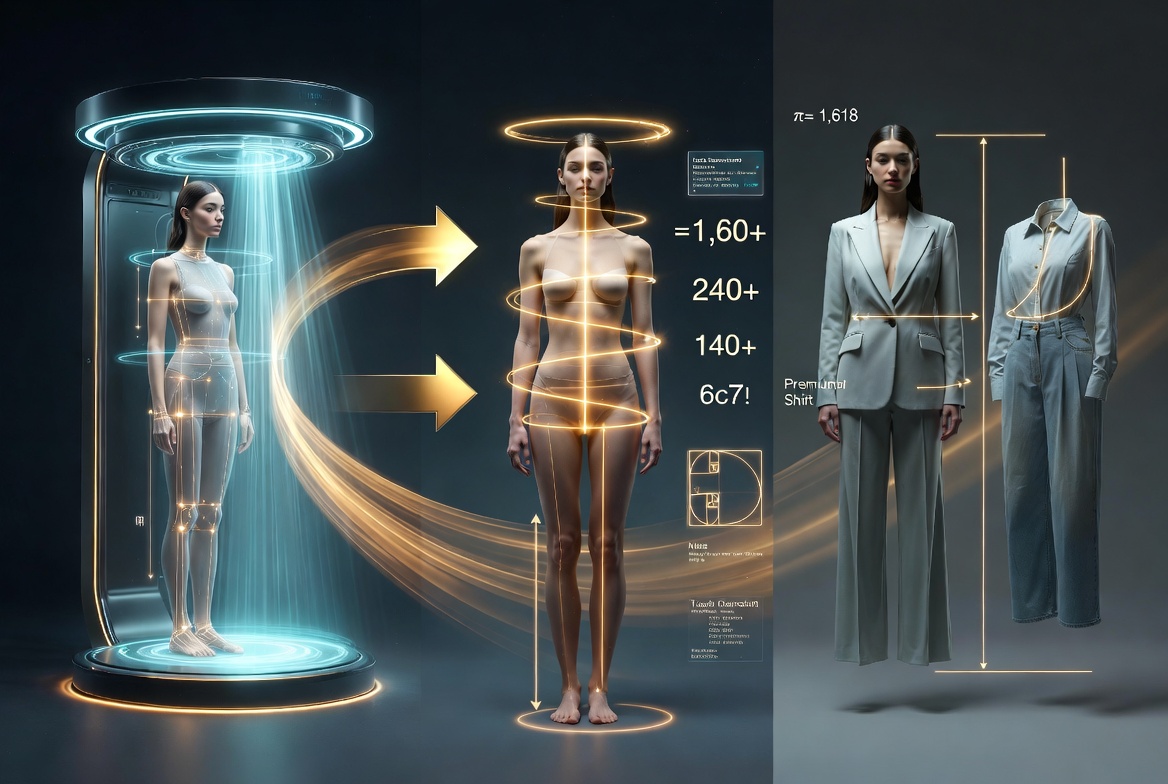
A 60-second scan in the VyMetric Totem produces what manual measurement cannot: hundreds of consistent, reproducible measurements captured the same way every time, regardless of operator. One scan generates a Biometric ID containing 240+ measurements: circumferences, lengths, posture indicators, asymmetries, slope angles, and proportional ratios that no tailor could produce in any reasonable amount of time.
But the measurements alone are not the breakthrough. The breakthrough is that they belong to the person, not the brand. Once a Biometric ID exists, it can inform every fit decision a consumer makes, across brands, across categories, across years. The body changes; the ID updates. The data becomes a permanent reference layer between the shopper and the garment.
This is what made-to-measure has been waiting for.
From one-off custom suit to lifetime fit profile
The old model of made-to-measure was transactional. You went somewhere, got measured, ordered a piece, and the relationship effectively ended at delivery. Each subsequent custom purchase started the friction cycle over.
The new model is continuous. A Biometric ID is a profile, not a transaction. A consumer who has been scanned can:
- Order custom shirts from one maker and custom denim from another, both informed by the same underlying data.
- See size recommendations against any participating brand's pattern blocks, eliminating the "what does their medium mean" problem.
- Track changes over time (useful for athletes, post-pregnancy, weight changes, aging) and update orders without re-measuring.
- Skip the in-store fitting stage entirely for repeat purchases.
This turns made-to-measure from a ceremony into infrastructure.
What this means for brands
For apparel brands, the most expensive customer is one who returns a garment that doesn't fit. Online apparel return rates routinely run between 20% and 40%, and fit accounts for the majority of those returns. Every returned garment is a triple loss: the original sale, the reverse logistics, and increasingly the environmental cost of items that often go to landfill.
Made-to-measure backed by accurate body data attacks this directly. When a garment is built to a real body rather than approximated to a size category, "doesn't fit" becomes a far rarer outcome.
Brands that integrate with a portable body data standard can offer made-to-measure without building proprietary measurement infrastructure of their own. They get the conversion lift and the return reduction. The consumer gets fit without the friction. The economics start to work. That's what unlocks scale.
What this means for consumers
The most underrated part of all this is what custom apparel feels like once it's normalized. Most people have never worn a pair of pants drafted to their actual rise and inseam, or a shirt with a yoke shaped to their actual shoulder slope. The first time you do, the experience is hard to unsee, and harder to give up.
Made-to-measure isn't about luxury. It's about the difference between clothing that fits the average of a hundred bodies and clothing that fits yours. That difference has always existed. What's new is that the path to it no longer runs through a tailor's appointment book.
It runs through a scan, an ID, and a brand willing to use them.
The direction
Custom apparel and made-to-measure are about to stop being separate categories from the rest of the apparel market. They are about to become a layer on top of it: available to anyone with a Biometric ID, applicable across brands, persistent across years.
Off-the-rack will still exist. It will just stop being the only realistic option for people who want their clothes to fit.
That's the future VyMetric is building toward, one scan at a time.
The body is the passport. We issue the ID.