Consumers Expected to Return Nearly $850 Billion in Merchandise in 2025
NRF's 2025 Retail Returns Landscape report shows a returns economy so large it could be its own Fortune 10 company. Here's what the data says and why fit is the unsolved root cause underneath it.
The headline number: $849.9 billion
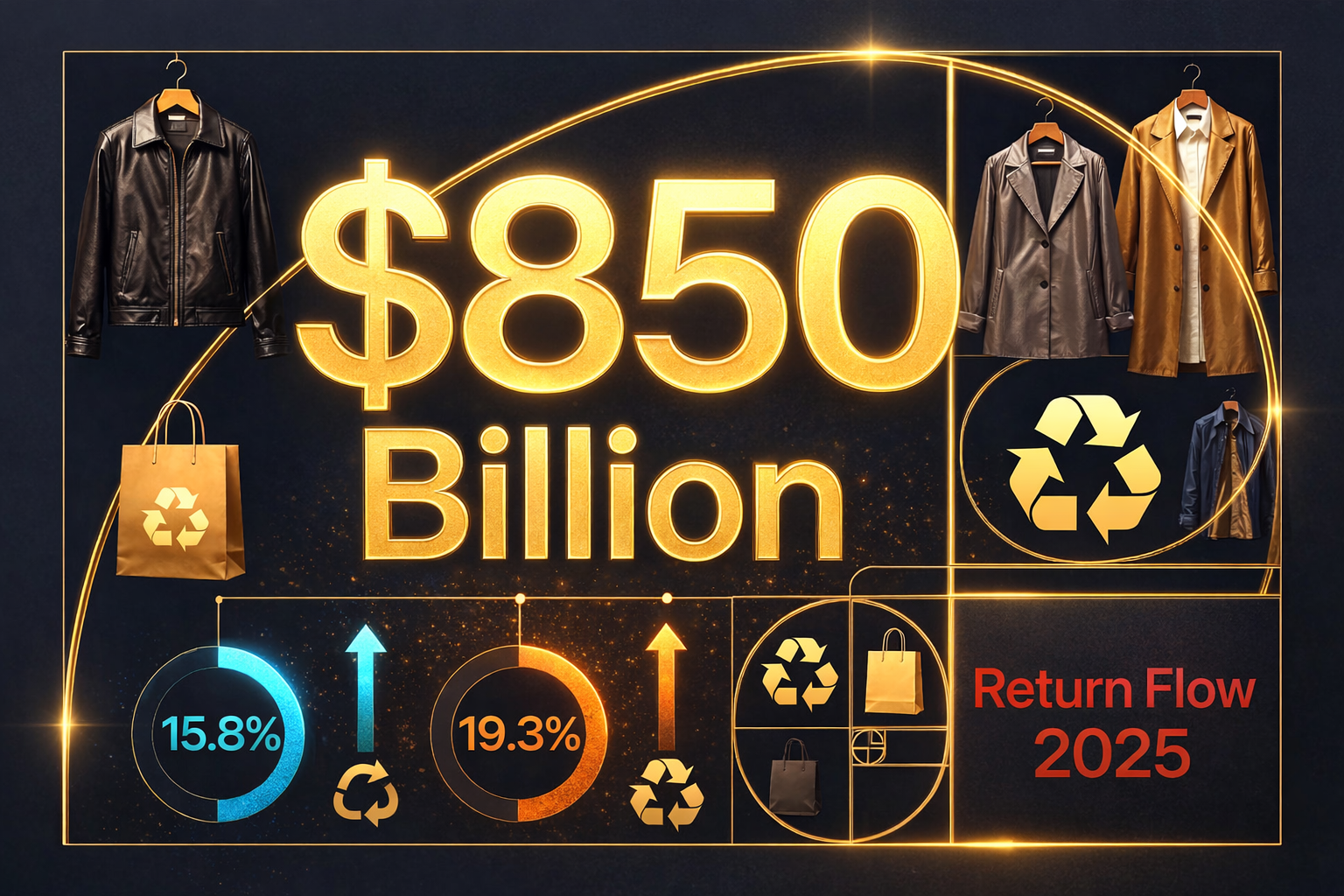
In October 2025, the National Retail Federation and Happy Returns published their annual Retail Returns Landscape report. The topline: U.S. retailers expect $849.9 billion in merchandise to come back across the counter this year, roughly 15.8% of all annual sales.
For context, that figure is larger than the 2024 GDP of Switzerland. It is a hidden second economy running parallel to retail, and one that retailers, carriers, and consumers are all absorbing costs from simultaneously.
Online is where the pressure compounds
While the total returns rate (15.8%) is roughly flat versus last year, the online channel tells a very different story. 19.3% of all online purchases are now returned. In apparel specifically, the category VyMetric cares most about, the number is meaningfully higher, and the vast majority of those returns trace back to a single reason: the garment didn't fit.
The NRF/Happy Returns data names three forces pushing that pressure higher:
- Processing cost inflation, 40% of retailers cite this as a driver of returns fees.
- Carrier shipping cost inflation, another 40%.
- Tariff and macro uncertainty, 33%.
Gen Z is not the villain, but they are the weather vane
Shoppers aged 18 to 30 average 7.7 returns per year on online purchases, more than any other generation. They are also the most likely to bracket (ordering multiple sizes intending to return most), to wardrobe, and to admit that "bending the truth" on a return form is acceptable.
It would be easy to frame this as a consumer ethics story. It isn't. It's a signal that the existing sizing system has broken down so completely that younger shoppers treat every purchase as a tentative hypothesis. Bracketing is what you do when you don't trust the size chart.
What retailers are doing about it
According to the report, 64% of merchants say updating their returns process is a priority in the next six months. Their 2026 top priorities are increasing online sales and simultaneously reducing return rates. Those two goals pull in opposite directions unless the underlying fit problem is fixed.
The operational playbook for the 2025 holiday season leans heavily on logistics tactics:
- 49% will rely more on third-party logistics partners.
- 43% will hire seasonal staff to process returns.
- 37% will extend return windows.
- 85% are using AI to detect or prevent return fraud.
These are reactive moves. None of them address the upstream cause.
Why VyMetric reads this report differently
Every headline in the NRF report is about what happens after a purchase goes wrong: reverse logistics, fraud detection, restocking, refund policies. Those are downstream fixes to an upstream problem.
The upstream problem is that no consumer owns a precise, portable record of their own body, and no brand has a standardized way to match a garment's real dimensions to a real person. So every online apparel purchase remains a guess. And a $849.9B problem is what happens when 330 million Americans guess, at scale, for a year.
VyMetric's thesis: returns don't need to be optimized. They need to be prevented. The infrastructure to prevent them is a consumer-owned Biometric ID, 240+ measurement points captured once, used across every brand, translating your actual body into the correct size in any sizing system on earth.
The body is the passport. We issue the ID.